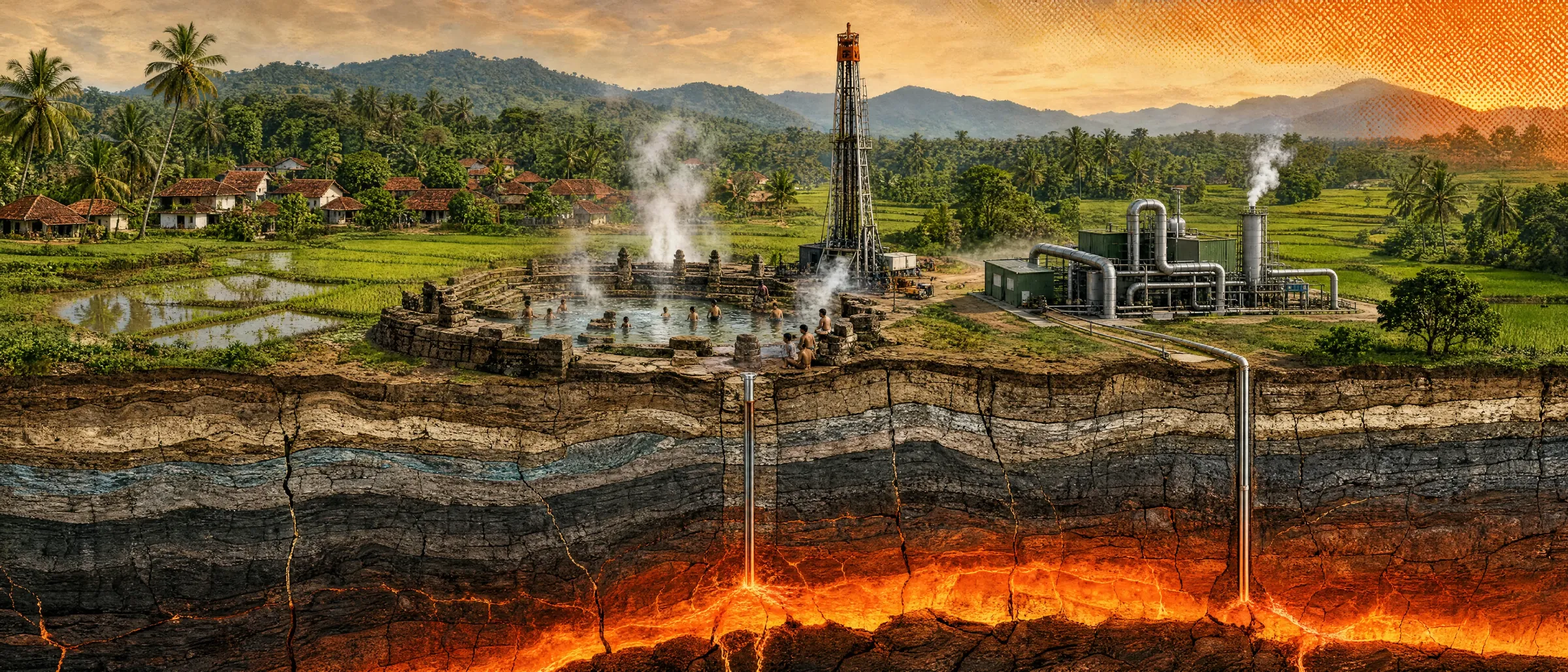
480 years
Of today’s electricity in the rock 3 to 7 km down, on paper.
20°C / km
How slowly the island warms with depth.
Rs 2.5 bn
First release: map the heat before drilling deep.
4 gates
Each stage paid for only if the last one passed.
Before the numbers
The water at Kanniya is warm for a reason
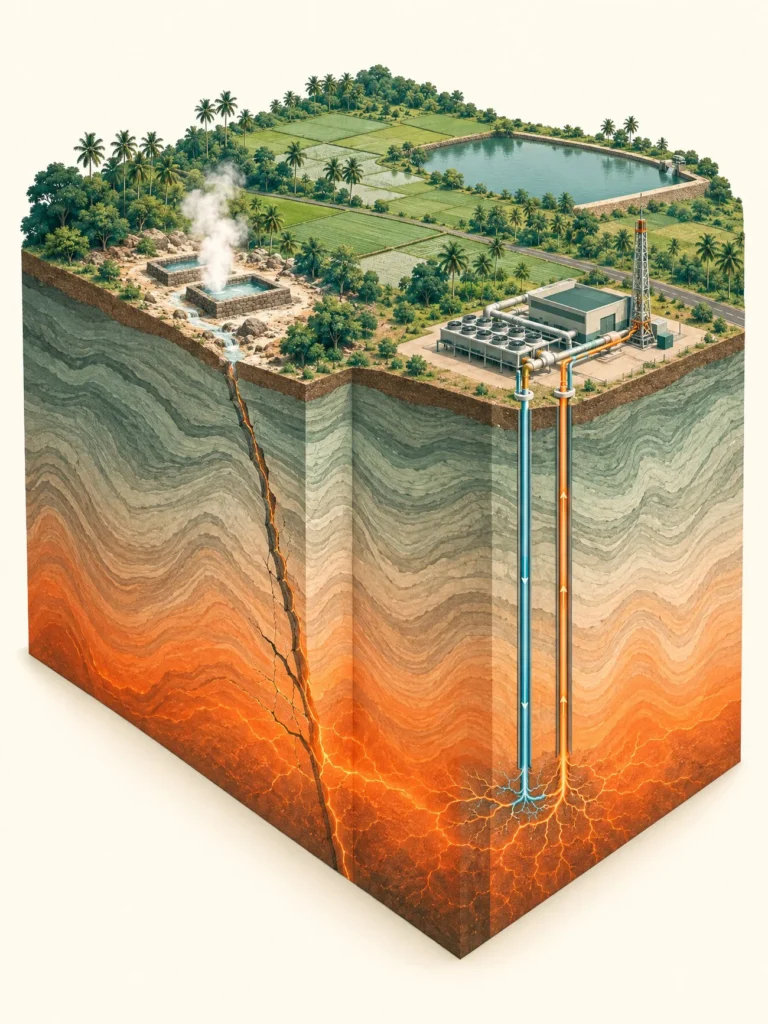
People have been drawing warm water from the stone wells near Trincomalee for longer than anyone has written it down. Nobody lights a fire under them. The water comes up warm because the ground it has passed through is warm.
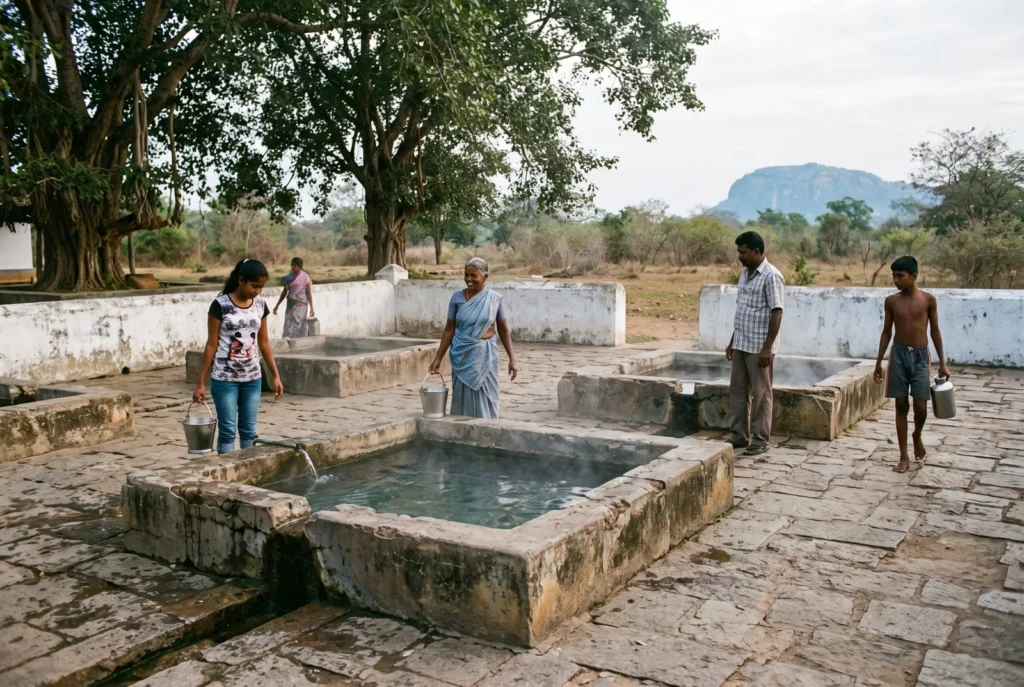
There are ten such springs on the island, strung along a 350 km line where the Highland and Vijayan rocks meet.S01 At the surface they run between 34 and 61°C. The chemistry of the water says it has been much hotter than that on its way up: somewhere between 88 and 138°C.S01 S02
That is the whole reason for this document. Rain falls on the hills, sinks several kilometres along cracks in the rock, is heated by nothing more than the natural warmth of the earth, and comes back up. The heat is real. It is under every part of the island, not only under the springs, and nobody has to import it.
What is not known is almost everything else. No deep well has ever been drilled on land to measure how hot the rock is at 3, 5 or 7 km. No one has measured how much water will flow through it. Every published figure for Sri Lanka’s geothermal power, including the well known 1,335 MW, is a calculation made from the surface.
This proposal makes two claims and keeps them apart. The first is physics, and it is solid: there is enough heat in the rock beneath Sri Lanka to matter for centuries. The second is economics, and it is open: whether that heat can be brought up at a price the country would choose to pay.
The fuel is free. The wells are not. The honest way to settle the second claim is to measure, in stages, and to stop when the measurements say stop.
The short version
Proven: the heat is there.
Unproven: the flow and the price.
Proposed: spend a little to find out, before anyone spends a lot.
The decision requested
Fund the map first. Release the drilling money one gate at a time
Rs 2.5 bn
first release: a national heat map and 12 shallow temperature holes
Rs 35.3 bn
whole programme to a working pilot, over five years, if every gate is passed
1 to 2 MW
size of the pilot plant. It is a measuring instrument, not a power station
0
megawatts promised by this document
What government is asked to approve
A national deep geothermal assessment in four stages. Stage 1 maps temperature at depth across the island using existing data, new surveys and shallow gradient holes. Stage 2 drills two slim exploration wells at the best sites. Stage 3 drills and flow-tests one deep well pair. Stage 4 builds a small pilot plant on those wells.
Only Stage 1 is requested now. Each later stage needs its own approval, backed by the measurements of the stage before and reviewed by an independent reservoir engineer.
The one rule
Measured temperature and measured flow decide the next rupee. Estimates, including the ones in this document, do not.
Why now
In 2025 Sri Lanka generated 18,052 GWh.S09 In the last quarter of that year coal and oil still supplied 36% of it.S10 The plan for 2030 leans on solar, wind, batteries and pumped storage, with imported gas as the firm supply.S12 Geothermal is the one clean source that runs day and night without fuel or weather.
Two things changed in 2026. On 30 September the first commercial engineered geothermal plant, in hot dry rock with no natural spring, began selling power in Utah.S15 On 26 October Singapore, which has no volcano either, announced a 15-month feasibility study after measuring 122°C at 1.76 km.S18 S19 The method is no longer experimental. Whether it suits Sri Lanka’s cooler rock is exactly what Stage 1 would find out.
What approval does not mean
It does not commit Sri Lanka to a geothermal power station. It authorises no deep drilling, no land acquisition, no hydraulic stimulation and no change to any hot spring. The sites named here are places with published data, not selected sites.
If the answer is no
A clear “not economic at today’s drilling prices” is a useful result. It costs Rs 2.5 billion to reach, it closes a question that has been open since 2011, and the temperature map stays valuable for groundwater, minerals and any later technology.
If money is short, drill fewer holes, not shallower ones. Never cut the baseline monitoring of springs, groundwater and seismicity.
How to read this proposal
Four labels
- Verified fact. A figure traceable to a named source in the register.
- Evidence from abroad. A result from another country. Useful, but not a prediction for Sri Lanka.
- Proposal. A design or policy choice this document recommends.
- Planning assumption. An input used to make a sum or a budget reviewable. It must be replaced by measurement or by quotation.
Source references appear as numbered tags such as S01. The register at the back gives the institution, document, date and web address for each.
What this document is not
It is a researched concept proposal built from public sources. It is not a resource assessment. It includes no field measurements, no site visits, no drilling quotations and no reservoir model.
No measured temperature from a deep well on land was found in the sources reviewed. Every temperature at depth quoted for Sri Lanka in this document is either a chemical estimate from spring water, a model, or a reading from an offshore petroleum well.
The megawatt figures in Part 1 come from published studies and are reported as their authors gave them. The heat and cost sums in Parts 2 and 5 are the author’s own and are shown in full in Appendix A so that anyone can check or replace them.
A reader who remembers one sentence should remember this one: the heat is certain, the flow is unknown, and the price depends on both.
Part 1: The evidence
Ten springs, a handful of studies, and not one deep hole. What is actually known is less than the headlines suggest, and more interesting.
Warm at the surface, much hotter on the way up
10
thermal springs recorded, on a 350 km north to south line
34 to 61°C
water temperature where it reaches the surface
88 to 138°C
hottest temperature the water has reached, from its silica chemistry
3.5 to 5 km
modelled depth the water travels to before returning
| Spring | Rock unit | At surface | Chemical estimate at depth |
|---|---|---|---|
| Nelumwewa | Vijayan | 61°C | about 121°C |
| Kapurella | Vijayan | 55°C | 113 to 143°C |
| Maha Oya | Vijayan | 54°C | 113 to 143°C |
| Marangala (Wahawa) | Vijayan | 48 to 54°C | about 122°C |
| Mahapelessa | Vijayan | 44°C | 100 to 132°C |
| Kanniya | Highland | 42°C | 76 to 107°C |
| Kivulegama | Vijayan | 34°C | 114 to 143°C |
| Rankihiriya, Mutugalwela, Embilinne | Mixed | not listed | not assessed |
Verified fact. Surface temperatures and silica or sodium-potassium estimates from the 2011 national assessment; Nelumwewa and Marangala depth estimates from the 2013 isotope study.S01 S02 The 2011 report itself warns that several samples had poor chemical balance and are less reliable.
Three things the chemistry proves
The water is ordinary rain. Its isotopes match local rainfall, not sea water and not magma.S02
It has been in contact with rock at roughly 100 to 140°C. That is hot enough to run a binary power plant, the kind that boils a second fluid with a lower boiling point.S01
There are open pathways several kilometres deep. Water does not sink and return through solid rock. Where a spring exists, a natural plumbing system exists.
One thing it does not prove
It does not say how much hot water is down there, or how fast it can be drawn. A spring that fills a few stone wells is a trickle. A power plant needs a river.
Different methods disagree. Other chemical thermometers put Maha Oya at 148°C and Marangala at 191°C.S08 A magnetotelluric survey team reported about 150°C as an average for four springs.S07 The spread is the point: only a thermometer lowered down a hole settles it.
How a spring gets hot without a volcano
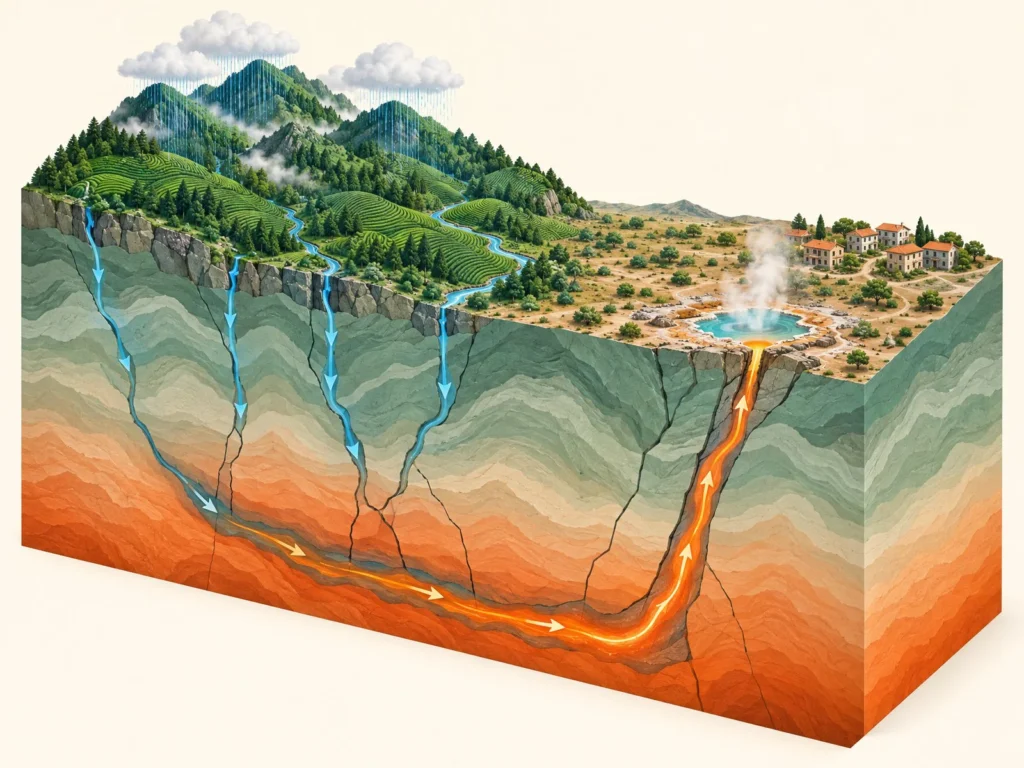
- Rain falls on high ground. The spring water is recharged by local rainfall, and the hills supply the height that drives it downwards.S02 S03
- It sinks along fractures. The 2025 model puts the deepest point of the journey at 3.5 to 5 km.S03
- The rock warms it. Ordinary background heat is enough. At about 20°C per kilometre, rock at 4 to 5 km is 108 to 128°C.
- It rises up a fault. Hot water is lighter. It climbs quickly along a steep break near the Highland and Vijayan boundary and cools on the way.
- It arrives at 34 to 61°C. What reaches the stone wells is the cooled tail of a much hotter system.
- No extra heat source is needed. The 2025 study tested and rejected magma and radioactive ore bodies as necessary explanations.S03
This is good news and a warning in one. The heat is ordinary, so it is everywhere. The heat is ordinary, so it is deep.
The island warms slowly. That changes every number that follows
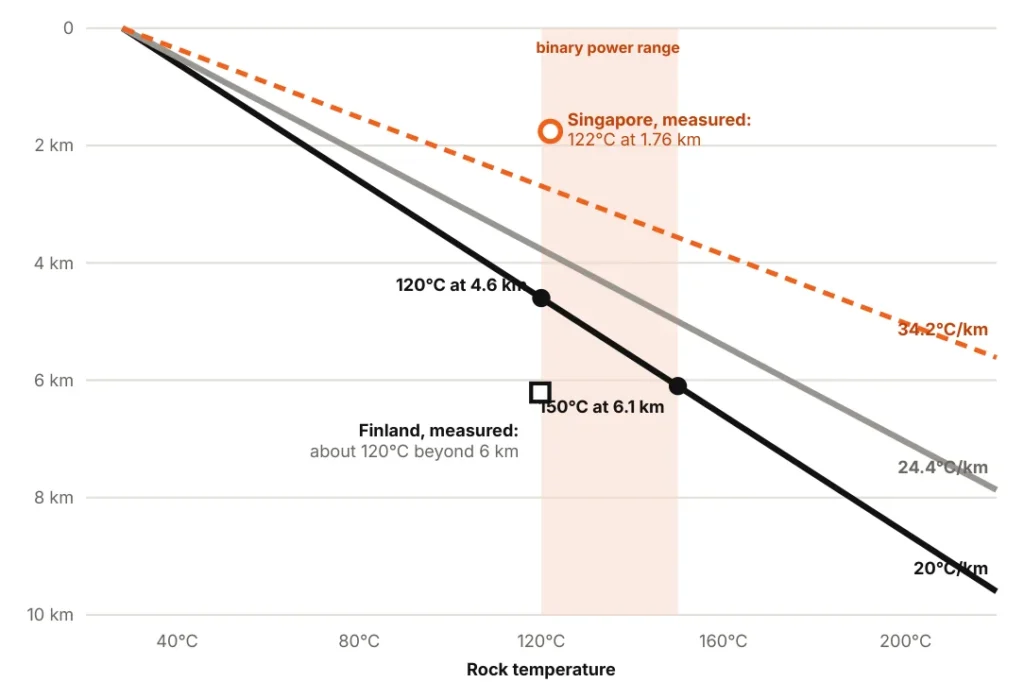
| Gradient | 100°C | 120°C | 150°C | 180°C |
|---|---|---|---|---|
| 20°C/km (2025 model) | 3.6 km | 4.6 km | 6.1 km | 7.6 km |
| 24.4°C/km (Mannar wells) | 3.0 km | 3.8 km | 5.0 km | 6.2 km |
| 34.2°C/km (one 1994 borehole) | 2.1 km | 2.7 km | 3.6 km | 4.4 km |
The finding that matters most
The 2011 national assessment, source of the 1,335 MW figure, placed its 100 to 140°C reservoir at 1 to 3 km. It did so by assuming the ground warms at about 35°C per kilometre. Its own text says that no gradient or heat flow data existed for the spring belt, and that the figure came from one borehole on Mannar Island, in different rock on the opposite coast.S01
Every measurement published since points lower. Petroleum wells in the Mannar Basin give 24.4°C per kilometre.S04 The global heat flow map gives Sri Lanka 45 to 58 milliwatts per square metre, ordinary for ancient crust, and the 2025 model built on it gives about 20°C per kilometre.S03
The same 120°C that looked like a 2.7 km well is, on current evidence, a 4.6 km well. In hard gneiss, that is the difference between a routine job and a frontier one.
One caveat in Sri Lanka’s favour
These are background figures. A fault that carries rising hot water is hotter than the rock around it at the same depth. That is why the springs exist. The first job of Stage 1 is to find where those warm columns are and how shallow they come.
Singapore lens
Singapore’s borehole at Sembawang read 122°C at 1.76 km, about 53°C per kilometre, because its granite makes its own heat.S19 Sri Lanka cannot borrow that number. It can borrow the habit of drilling a hole before quoting one.
What the megawatt figures can prove, and what they cannot
| Study | Area covered | Result | How this proposal uses it |
|---|---|---|---|
| National assessment, 2011 S01 | 350 km belt, 1,000 km² by 2 km thick, 120°C | 1,335 MW for 50 years 723 MW for 100 years | The headline. A stored-heat sum with assumed area, thickness and 25% recovery. Range given by its own simulation: 715 to 2,515 MW |
| University of Peradeniya S05 | Maha Oya and Kapurella | 455 MW for 30 years 273 MW for 50 years | Same method on one field. May overlap the national figure. Not added to it |
| University of Peradeniya S05 | Wahawa | 12.1 MW for 30 years | Conflicts with the row below |
| University of Moratuwa, 2025 S06 | Wahawa, with gravity, magnetic and resistivity surveys | 2.6 MW for 30 years | The only estimate tied to a surveyed reservoir shape. Five times smaller than the one above for the same field |
| University of Peradeniya S05 | Nelumwewa | 6.2 MW for 30 years | Small field, direct heat candidate |
All of these are the same kind of number
Each one takes a block of rock, assumes its size and temperature, works out the heat it holds above a cut-off, assumes a fraction can be recovered, converts a few percent of that to electricity and spreads it over a number of years. Change the block and the answer changes in proportion.
The 2011 worked example can be reproduced exactly: 1,000 km² by 2 km at 120°C, cooled to 80°C, holds 2.09 × 10²⁰ joules. A quarter of that over 50 years is 33 GW of heat. At the report’s 5% conversion that is about 1,660 MW of electricity; its simulation, which varies the inputs, gives 1,335 MW as most probable.S01
Now shrink the productive area to 200 km² and the recovery to 10%, both reasonable for fractured hard rock. The same sum gives about 130 MW.
What none of them measured
- Temperature in a hole deeper than a few hundred metres
- How easily water moves through the rock
- How much water a well would give, and for how long
- How fast the rock around a well would cool
- What any of it would cost
How to read the spread
From 2.6 MW to 2,515 MW is a range of a thousand to one. That is not a sign that someone is wrong. It is what a resource looks like before anyone has drilled it. Peradeniya’s own summary is plain: accessible economic geothermal resources in Sri Lanka are limited.S05
Mapping the productive volume and measuring flow is worth more than refining any of these figures to another decimal place.
Part 2: The size of the prize
How much heat is under Sri Lanka, worked out from scratch with every step shown. The answer is very large. The usable part is the question.
Throw away 98% of the heat. Centuries are still left
Take the slab of rock between 3 and 7 km beneath the whole island. Count only the heat above 80°C. Then be harsh about how much can ever be used.
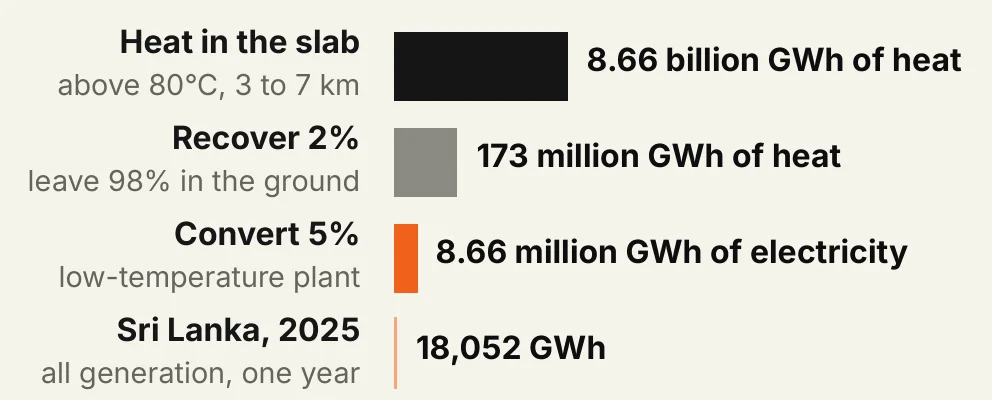
480 years
of 2025 generation, from under the whole island
24 years
if only 5% of the land could ever be drilled
4.8 years
if only 1% of the land, about 656 km², could be drilled
| Case | Whole island | 5% of land | 1% of land |
|---|---|---|---|
| 20°C/km, 5% conversion | 480 years | 24 years | 4.8 years |
| 20°C/km, 8% conversion | 768 years | 38 years | 7.7 years |
| 24.4°C/km, 5% conversion | 700 years | 35 years | 7.0 years |
| 24.4°C/km, 8% conversion | 1,119 years | 56 years | 11 years |
Planning assumption. Area 65,610 km². Rock heat capacity 2.475 million joules per cubic metre per degree, the value used in the 2011 assessment. Surface 28°C. Recovery of 2% is the conservative case of the 2006 MIT panel; 5% conversion is the 2011 assessment’s figure.S01 S25 Years are multiples of 2025 net generation.S09 Full working in Appendix A.
What this sum proves
That the heat exists in quantities that dwarf the country’s electricity use. It is simple physics: hot rock, known volume, known heat capacity. A geologist would argue about the gradient, not about the conclusion.
What it does not prove
That any of it can be produced at a price worth paying. “Years of supply” in this table is a measure of how much heat there is. It is not a forecast, and it is not a reserve in the sense a mining company would use the word.
Why it is the same everywhere
A sum like this gives a large answer for almost any country. The International Energy Agency’s 2024 study found that engineered geothermal has the technical potential to meet world electricity demand many times over.S17 Singapore’s 2026 survey put its technical potential at more than 60 times its yearly electricity use.S18 Technical potential is the easy part.
The honest headline
Sri Lanka has centuries of heat under its feet. Whether it has decades of affordable electricity there is a separate question, and it can only be answered with a drill.
The fuel costs nothing. Reaching it costs almost everything
It is a store, not a stream
Heat leaks up through Sri Lanka’s crust at 45 to 58 milliwatts per square metre.S03 Across the whole island that is about 3.0 to 3.8 GW of heat, all day, every day. It sounds like a lot. The country’s average electrical load in 2025 was 2.06 GW.
But a low-temperature plant turns only about 5% of heat into power. If every square metre of the island’s natural heat flow could be caught, it would make about 164 MW.
So deep geothermal here does not live on the trickle. It draws down heat stored in the rock over millions of years. Around each well the rock cools over a few decades and recovers over centuries. That is heat mining. It is clean and it lasts generations, but it should not be sold as endless.
Water is the carrier
Rock holds the heat; water carries it out. Each litre brought up at 150°C and sent back at 80°C delivers a fixed parcel of heat. To move more heat, move more water. That takes more wells or wells that flow faster, and in tight crystalline rock flow is the hardest thing to get.
What 1,000 MW would physically require
| Requirement at 150°C | Amount |
|---|---|
| Heat drawn from the rock | 10 to 12.5 GW |
| Hot water circulated | 34 to 43 tonnes a second |
| Production wells at 80 kg a second each | 425 to 531 |
| Net power per production well | 1.9 to 2.4 MW |
| Depth of each well, at 20 to 24.4°C/km | 5.0 to 6.1 km |
| Rock cooled over 30 years, at 10 to 20% recovery | 307 to 614 km³ |
Planning assumption. Conversion 8 to 10%; water reinjected at 80°C; 90% running time. A flow of 80 kg a second per well is at the upper end of what engineered wells have reported in public. Injection wells are extra.
Read that table slowly
A gigawatt in Sri Lanka’s rock is not one power station. It is several hundred of the deepest wells ever drilled on the island, spread over many fields. That may one day be sensible. It is not where to start.
The useful first question
Can one pair of wells, at one good site, give 1 to 2 MW for a year without cooling, losing water or shaking the ground? If yes, the rest is engineering and finance. If no, the country has saved itself billions.
“Free energy” is the wrong promise. “Fuel-free, weather-free, import-free power, if the wells can be paid for” is the right one.
One island, three kinds of geothermal, three levels of readiness
A · The spring belt
Megawatts to tens
What it is. Natural hot water rising along faults near the ten springs. The plumbing already exists.
Temperature. 100 to 140°C by chemistry.
Depth. Unknown. The warm column may come within 1 to 3 km of the surface. Stage 1 and 2 test exactly this.
Use. Small binary plants and direct heat for drying, cooling and bathing.
Readiness. Proven technology. Unproven resource.
B · Deep hot rock
Hundreds of megawatts
What it is. Dry crystalline rock at 150°C and above, with flow paths made by engineering.
Temperature. 150 to 180°C.
Depth. 5 to 7.6 km on current evidence.
Use. Grid-scale firm power, field by field.
Readiness. Working commercially in much hotter, shallower rock abroad since September 2026. Not yet shown in rock as cool as Sri Lanka’s.
C · The whole crust
Centuries, on paper
What it is. All the heat between 3 and 7 km, or deeper, under the island.
Temperature. Up to about 170°C at 7 km.
Depth. Wherever drilling becomes cheap enough.
Use. None today. A reason to keep watching deep-drilling costs.
Readiness. A resource figure, not a project.
Why start with A
It is the cheapest place to learn the most. A slim hole into a fault near a spring answers three questions at once: how hot, how deep, and whether water moves. If the warm column is shallow, Sri Lanka has a modest resource it can use within this decade with off-the-shelf plant. If it is not, the country has a measured gradient to judge B against.
Why not skip to B
Because B in Sri Lanka means wells of 5 to 7 km in hard gneiss, and the nearest real-world test of that, in Finland, reached the temperature and failed on flow. Part 3 tells that story.
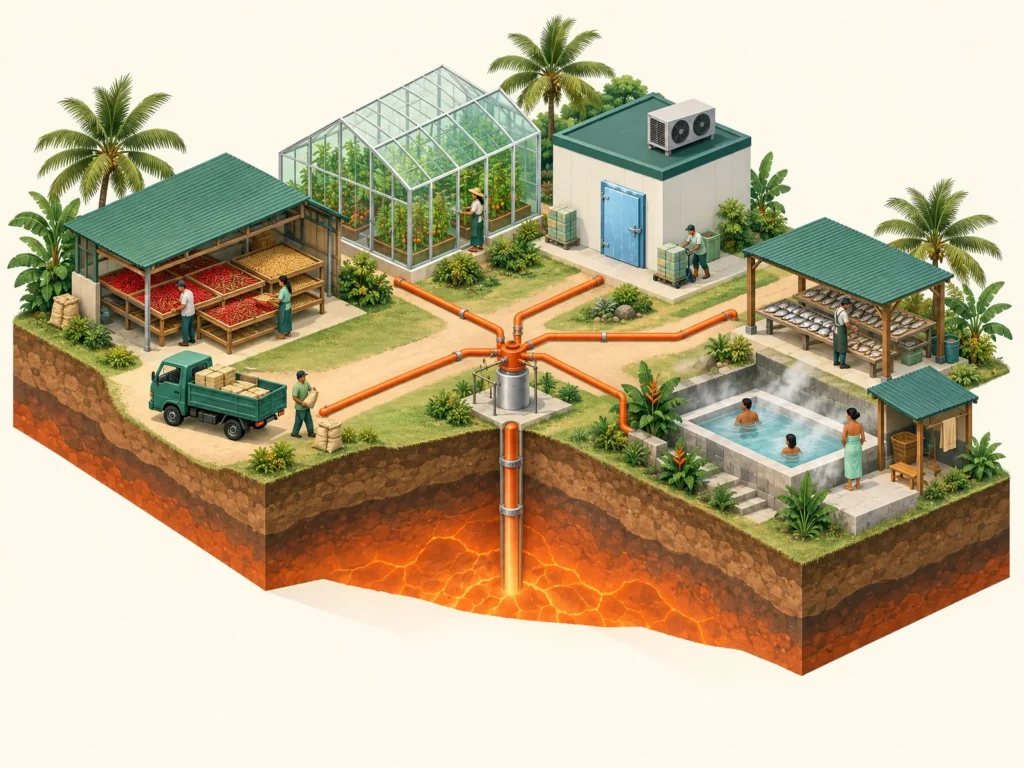
Proposal. The 2011 assessment suggested that most of the heat would be better used directly, for cooling and industry, than turned into electricity at 5% efficiency.S01 Stage 1 should map heat demand near each spring as well as heat supply.
Part 3: Proof it can be done
One plant that works, one country doing the homework properly, and two projects that went wrong. Sri Lanka needs all four lessons.
Utah, 2026: making a reservoir where nature did not
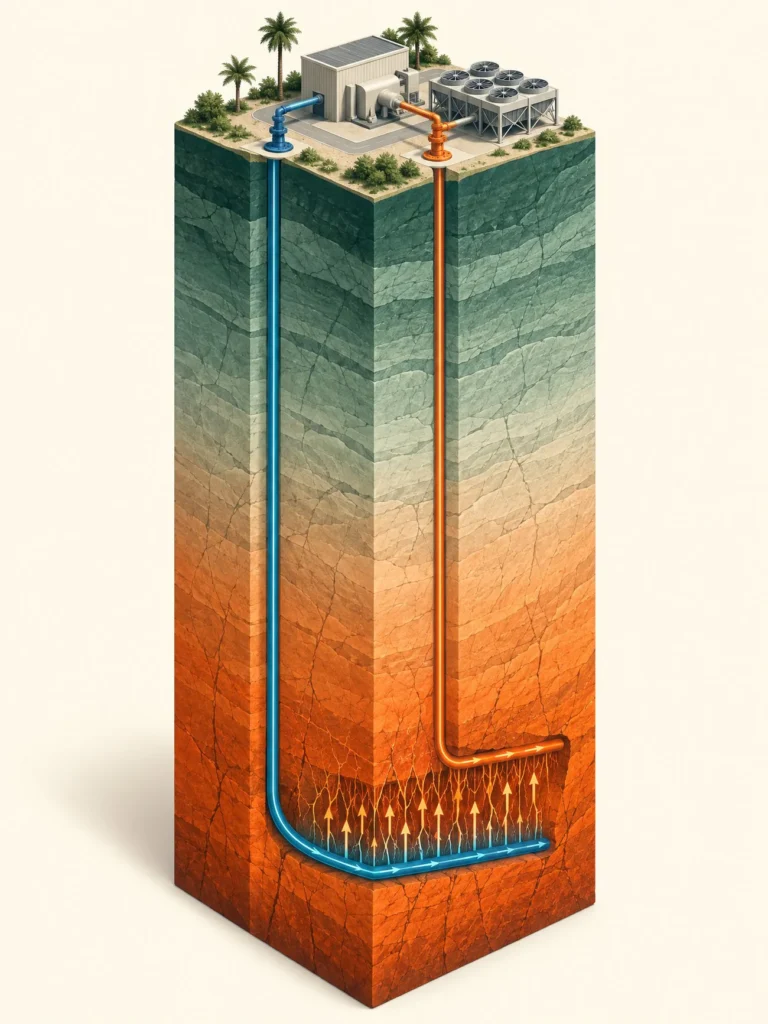
- Two wells, not one. One injects cool water. One produces hot water. The plant sits between them.
- Turn sideways at depth. Borrowed from oil and gas: the wells bend and run level through the hot rock, so each one touches far more of it.
- Open the rock. Water under pressure opens thousands of small cracks between the two wells. This is the step that makes or breaks a project.
- Closed circuit. The same water goes round and round. Nothing is burned and almost nothing is vented.
What happened in 2026
Evidence from abroad. Fervo Energy’s Cape Station in Utah began commercial operation on 30 September 2026 with a first 33 MW unit, the first new-site engineered geothermal plant in the world to do so.S15 The developer gives its installed cost as about US$7,000 per kilowatt for the first 100 MW and US$5,500 for the next 400 MW, with a long-term aim of US$3,000.S16
Two cautions. Every one of those cost figures comes from the developer; none has been independently audited. And the plant had weeks of operating history when this document was written, not years.
Utah is not Sri Lanka
The Utah wells reach rock at about 220°C.S15 At Sri Lanka’s 20°C per kilometre, 220°C lies 9.6 km down. At a realistic 150°C, each litre of water carries roughly half the usable heat, and the plant converts less of it. Deeper wells, each producing less: that is the arithmetic Sri Lanka has to beat.
The International Energy Agency projects that next-generation geothermal costs could fall by 80% by 2035, to around US$50 per MWh in good conditions.S17 That is a projection, not a quotation.
Singapore lens: a country with no volcano that did the homework in order
122°C
measured at 1.76 km in a slim borehole at Sembawang
2 years
nationwide survey from the air and the ground, 2024 to 2026
60 ×
yearly electricity use: the technical potential it reported
15 months
feasibility study that follows, on safety, viability and cost
What Singapore did, in order
- Started at its one hot spring. Researchers drilled two slim boreholes: 70°C at 1.12 km at Admiralty, then 122°C at 1.76 km near Sembawang.S19
- Surveyed the whole island without drilling. A consortium mapped the underground to about 10 km with aircraft and ground sensors.S18
- Published a technical potential, and called it that. The regulator said in the same breath that further study must decide how much can feasibly be extracted.S18
- Commissioned a feasibility study before any plant. Fifteen months, covering safety, technical viability and the cost of production.S18
- Made no promise. The official line is that any decision waits on the studies and on progress in deep drilling.S18
| Copy | Adapt | Leave |
|---|---|---|
| Drill a slim hole before quoting a temperature | National survey: start with the 350 km spring belt, then widen | The 122°C figure. Singapore’s granite is far hotter than Sri Lanka’s gneiss |
| Call technical potential by its name | Feasibility study: add direct heat use, which matters more at lower temperatures | The “60 times” headline as a model for communication |
| Regulator leads, universities measure, consultants review | Use local universities already working on the springs | Any assumption of a similar timetable to power |
| Publish each stage |
The lesson
Singapore spent years and two boreholes before it allowed itself one sentence about potential. Sri Lanka has had a 1,335 MW headline since 2011 and has not yet drilled the hole that would test it. The order should be reversed.
Evidence from abroad. Singapore’s heat flow is reported as at least twice the continental average.S19 Sri Lanka’s sits at or below average.S03 The method transfers. The result does not.
Singapore’s survey also found cooler heat at shallow depth, useful for industrial heating and cooling.S18 For Sri Lanka that may be the nearer prize.
Finland and Korea: two projects every Sri Lankan plan should be tested against
Finland · The closest match to Sri Lanka’s rock
Reached the heat. Could not get the flow.
At Otaniemi near Helsinki, the energy company St1 drilled two wells to 6.2 and 6.4 km in ancient granite between 2016 and 2020, the deepest industrial geothermal wells in the world.S20
The ground there warms at about 17°C per kilometre with a heat flow of 52 milliwatts per square metre.S20 Sri Lanka’s figures are 20 and 45 to 58. It is the nearest thing to a rehearsal that exists.
The temperature target was met: about 120°C at the bottom. The wells were connected. But only around 100 litres a minute could be pushed through, where a 10 MW heat plant needed about 3,000. Drilling cost four times the estimate. The project never reached commercial operation and the wells are now used for research.S20 S26
Lesson. In old, cool, hard rock, temperature is the easy half. Budget and plan around flow.
Korea · What careless stimulation can do
A magnitude 5.5 earthquake.
On 15 November 2017 an earthquake of magnitude 5.5 struck Pohang. An international investigation concluded that high-pressure injection at an engineered geothermal site about 4 km deep had activated a fault nobody had mapped. Dozens of people were hospitalised and the project was halted.S22
Finland, a year later, shows the other way. During its 6.1 km stimulation, 24 seismometers fed a traffic-light system with a hard limit set by the authorities. Pumping was slowed whenever activity rose. The largest event was magnitude 1.9.S21
Lesson. Map faults first. Agree a stop limit with the regulator before pumping. Put the monitoring network in a year ahead, so there is a baseline. Sri Lanka’s low natural seismicity is an advantage only if it is measured before work starts.
And one encouragement
Evidence from abroad. At Chena Hot Springs in Alaska a binary plant has made electricity from 74°C water since 2006.S23 It works because the plant is cooled by water at 4°C. In Sri Lanka the air is 28°C, so the same machine needs hotter water to do the same job. Even so, it shows that 100 to 140°C is well inside what today’s plant can use.
| Place | Depth | Rock temperature | Outcome |
|---|---|---|---|
| Utah, USA | 4.4 km of well | about 220°C | Commercial, 2026 |
| Sembawang, Singapore | 1.76 km | 122°C | Feasibility study |
| Otaniemi, Finland | 6.4 km | about 120°C | Halted on flow |
| Sri Lanka, modelled | 4.6 km | 120°C | Not drilled |
Utah figure is average well length including the sideways section, so the vertical depth is less.S15
Part 4: The programme
Four stages over five years. Each one is small enough to stop, and each one buys the evidence that decides the next.
Four stages, four gates, one question at a time
Stage 1 · 2027: Map the heat
Collect every existing log and sample. Measure heat flow. Resurvey four spring fields. Drill 12 shallow gradient holes. Start baseline monitoring.
Gate 1. Is there at least one site where the evidence points to 100°C within about 3 km?
Stage 2 · 2028: Touch it
Two slim exploration wells to about 2.5 km at the two best sites. Log temperature all the way down. Test whether water moves.
Gate 2. Did the thermometer agree with the map, and is there any natural flow?
Stage 3 · 2029 to 2030: Test the flow
One production well and one injection well at the stronger site. Circulate water between them for at least 30 days under seismic watch.
Gate 3. Sustained flow, small water loss, no event above the agreed limit.
Stage 4 · 2030 to 2031: Run a pilot
A 1 to 2 MW binary plant on the tested wells, with a direct-heat user beside it. Run for a year and publish everything.
Gate 4. Measured net output and measured cost per unit. Then decide on a first field.

How a gate works
Before each stage the assessment team submits its measurements, an updated cost estimate and a recommendation. An independent reservoir engineer, with no interest in the next contract, reviews them. The ministry publishes both. Treasury then releases the next stage, repeats the stage at another site, or closes the programme.
The gate tests on this page are starting proposals. The reviewer should fix numeric pass marks before each stage begins, not after its results are in.
Three ways it can end well
- A shallow warm column is found. Small plants and direct heat at the springs become bankable within the decade.
- The rock is hot but tight. The pilot defines what engineered flow costs here, ready for when drilling gets cheaper.
- Neither. The programme stops early, the map is published, and the 1,335 MW question is finally closed.
The programme is designed so that stopping at any gate is a result, not a failure.
Map the heat, then touch it
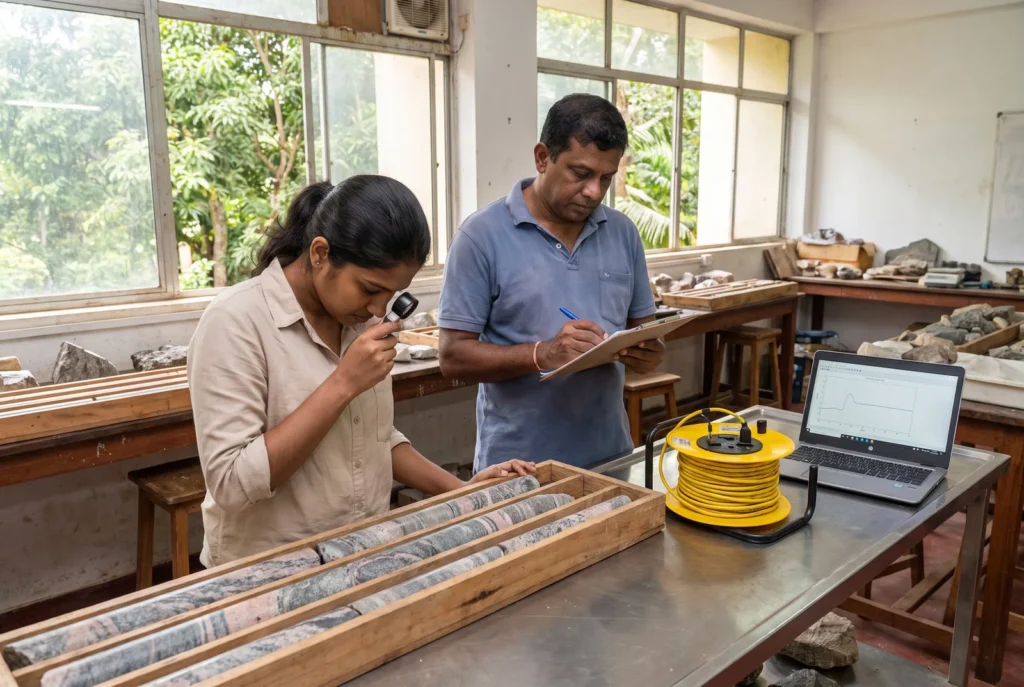
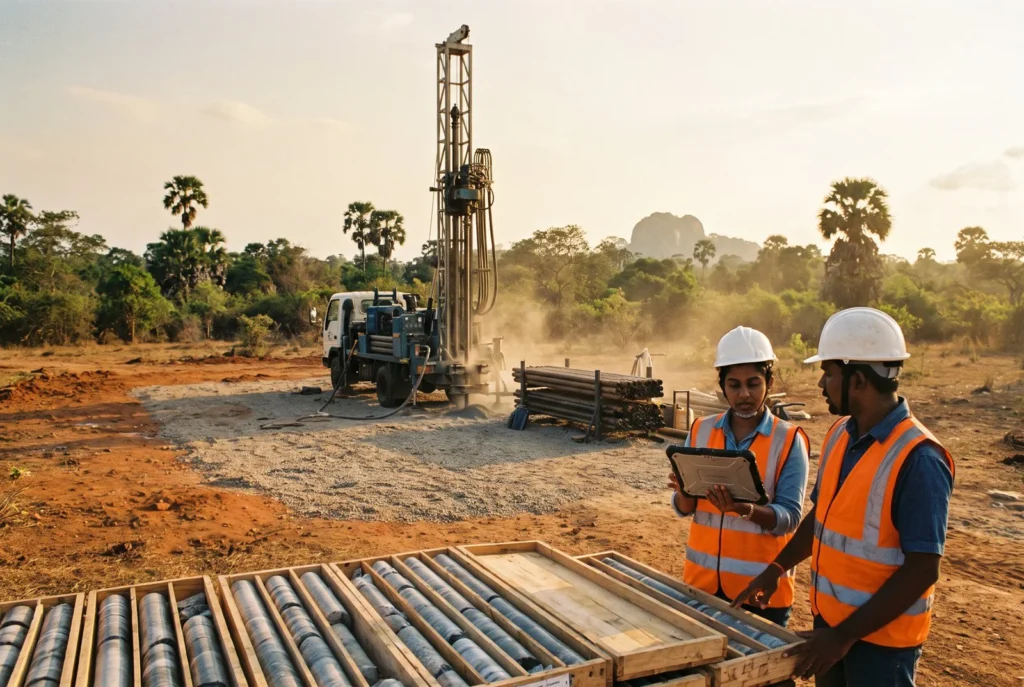
Stage 1: What the first release buys
| Work | Output |
|---|---|
| Data inventory | Every existing borehole log, mine record, water well and petroleum well temperature, in one public file |
| Heat flow | Thermal conductivity and heat production measured on rock samples from each main rock unit |
| Geophysics | Magnetotelluric, gravity and resistivity lines across Maha Oya and Kapurella, Wahawa, Nelumwewa and Mahapelessa |
| 12 gradient holes | 300 to 500 m each, on and off the faults, logged after the hole has settled |
| Heat demand | Who within 20 km of each spring could use heat: mills, dryers, cold stores, hotels |
| Baselines | Spring flow and chemistry, groundwater levels and a seismic network, running before any deep work |
| Deliverable | Temperature maps at 3, 5 and 7 km with the uncertainty drawn on them, and a ranked site list |
Stage 2: Two slim wells
A slim well is narrow, quicker and cheaper than a production well. It cannot produce power. It can do the one thing no survey can: put a thermometer in the rock at 2.5 km.
Each well is cored where it matters, logged for temperature and fractures, and tested by pumping water in and watching how fast the pressure falls. That last test is the first real measure of whether water will move.
Where to look first
Proposal. Rank sites by expected temperature at reachable depth, drilling difficulty, water availability, distance to a grid line, nearby heat users, and what must be protected. Include at least one site away from any spring, so that the background gradient is measured and not only the hot spots.
Protect the springs
The hot springs are bathing places, places of worship and, in some cases, protected heritage. No well should be sited where it could change a spring’s flow or temperature. Spring users are consulted before any hole is located, and each spring is monitored throughout.
Singapore lens
Singapore’s first two boreholes were described to its Parliament as similar to ordinary soil investigation holes, and the research team consulted technical agencies on environmental safeguards before drilling.S18 Small, plain and explained in advance is the right tone for Stage 1.
Test the flow, then run a pilot and publish what it does
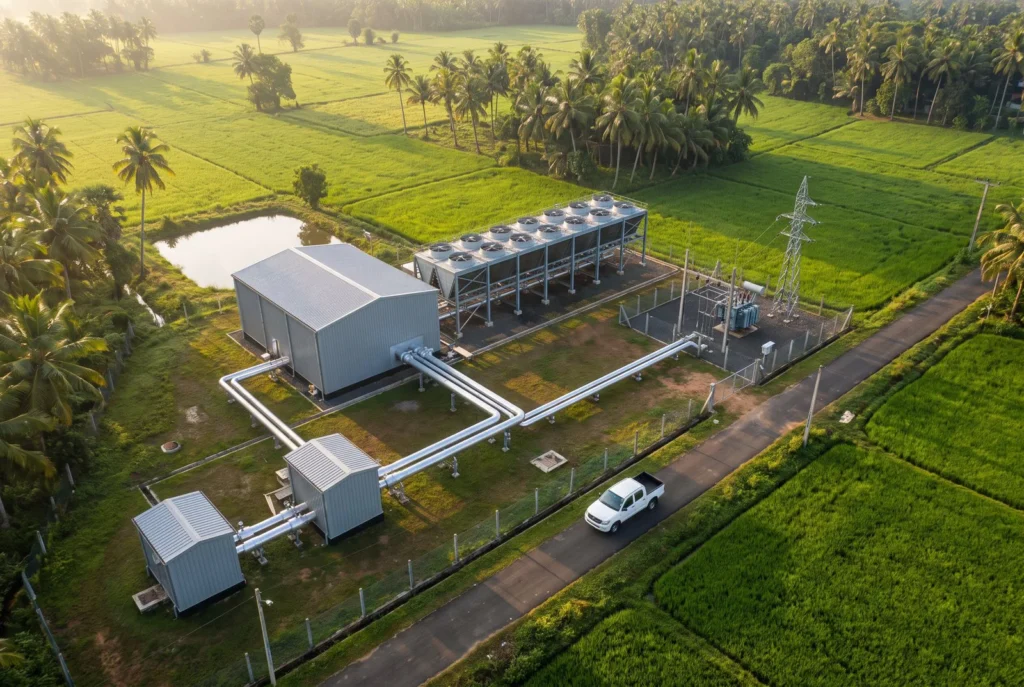
Stage 3: The test that decides everything
One production well and one injection well are drilled to the depth the slim well justified. Water is circulated between them for at least 30 days.
| Measure | Why it matters |
|---|---|
| Sustained flow rate | Sets the power per well, and so the cost |
| Injection pressure | Sets the pumping power the plant must give back |
| Water lost underground | Sets the make-up water a site must find |
| Tracer return time | Shows whether water short-circuits and cools early |
| Seismic events | Must stay below a limit agreed in advance |
If natural flow is poor, engineered stimulation is assessed as a separate decision, with its own approval, fault map, monitoring and stop limit. It is not assumed.
Stage 4: A pilot sized to the wells
Planning assumption. At 80 kg a second, one well pair gives about 1.2 MW from 120°C water and about 1.9 MW from 140°C water. That is why the pilot is 1 to 2 MW and not larger. A bigger turbine on the same wells would simply run part-loaded.
At 2 MW and 90% running time the pilot would make 15.8 GWh a year, about 0.09% of 2025 generation. Its job is to produce numbers, not to move the grid.
What the pilot must publish
- Gross output, the plant’s own consumption, and net output, month by month
- Wellhead temperature over time, to show the cooling rate
- All-in cost per unit, including the wells that came before
- Every seismic event recorded and every day of downtime
- Heat sold to the direct-use partner and what it replaced
A pilot that hides its net output has measured nothing. Net power to the grid is the only figure that counts.
Part 5: The money
Rs 2.5 billion buys the map. Everything after that is spent only if the map earns it. The sums are shown in full.
Rs 35.3 billion to a working pilot, released in four parts

| Stage and main items | US$ M | +25% | Rs bn |
|---|---|---|---|
| 1 · Map the heat, 2027 Office and reviewer 0.6 · data 0.3 · heat flow 0.4 · geophysics 1.5 · 12 gradient holes 2.4 · baselines 0.8 | 6.0 | 7.5 | 2.50 |
| 2 · Two slim wells, 2028 Two wells to about 2.5 km 12.0 · logging, testing, review 2.0 | 14.0 | 17.5 | 5.82 |
| 3 · Deep flow test, 2029 to 2030 One well pair 34.0 · circulation and tracer tests 6.0 · monitoring 2.0 · engineering and review 3.0 | 45.0 | 56.3 | 18.71 |
| 4 · Pilot plant, 2030 to 2031 2 MW binary plant 10.0 · grid and site 4.0 · direct-heat demonstration 2.0 · one year of operation 4.0 | 20.0 | 25.0 | 8.32 |
| Total, if every gate is passed | 85.0 | 106.3 | 35.35 |
Planning assumption. 2026 prices. Converted at Rs 332.7 to the US dollar, the mid-November 2026 market rate.S14 These are the author’s concept allowances, not quotations. A screening range of 30% below to 60% above, about US$74 to 170 million, is a judgement and not a statistical interval. Taxes, land and foreign-exchange cover are not included.
Where the allowances come from
Evidence from abroad. The World Bank’s geothermal handbook puts surface exploration at US$2 to 4 million and a test-drilling campaign of three to five wells at US$11 to 30 million, in 2012 prices and in volcanic fields with shallower wells.S24 Sri Lanka’s wells would be fewer but deeper and in harder rock, and Finland’s deep wells cost four times their estimate.S26 The allowances here sit above the handbook figures for that reason.
For scale
Sri Lanka spent more than US$4.7 billion on imported fossil fuels in 2024.S13 Stage 1 is about 0.16% of one year of that bill. The whole programme is about 2.3%.
In the last quarter of 2025 the energy cost of generation was Rs 68,983 million.S10 Stage 1 costs about what the country spent on the energy cost of generation in a little over three days.
Who should pay
Exploration is the stage private money avoids, because most of the risk sits there. The usual answer is public or development-partner funding for exploration and private capital once a resource is proven.S24 Partner support for Stage 1 is worth seeking. It is a possibility, not a commitment.
Only the first Rs 2.5 billion is requested now. The other Rs 32.9 billion exists in this document so that nobody is surprised later.
Capital decides the price. Depth decides the capital
Capital cost alone, per unit of electricity
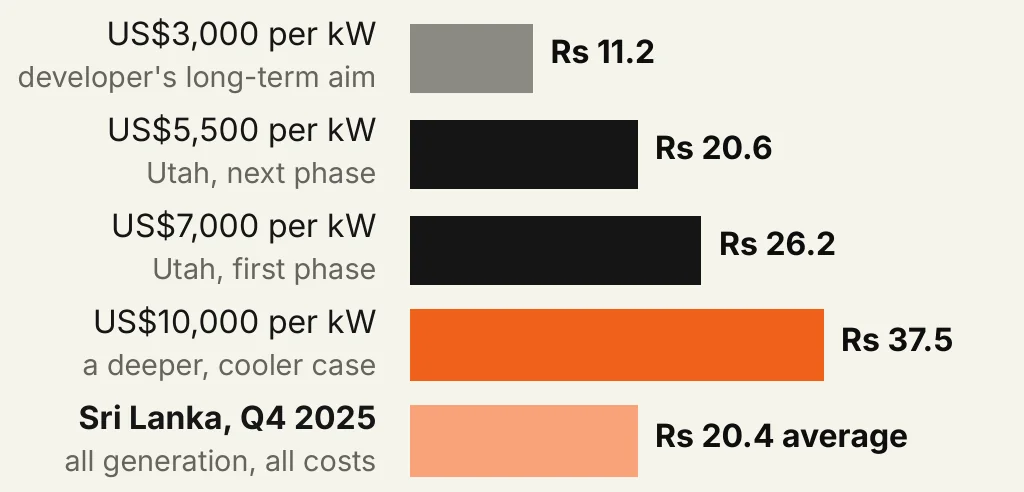
| Capital cost | US cents, 8% | Rs, 8% | US cents, 12% | Rs, 12% |
|---|---|---|---|---|
| US$3,000 per kW | 3.4 | 11.2 | 4.7 | 15.7 |
| US$5,500 per kW | 6.2 | 20.6 | 8.7 | 28.8 |
| US$7,000 per kW | 7.9 | 26.2 | 11.0 | 36.7 |
| US$10,000 per kW | 11.3 | 37.5 | 15.8 | 52.4 |
How to read this
At Utah’s own figures, geothermal capital alone lands close to what Sri Lanka’s whole generation mix cost per unit in late 2025. That is before operating costs, and Utah’s rock is far hotter.
Sri Lanka’s wells would be deeper and each would deliver less. No one can say today whether that puts the real figure at US$7,000 or US$15,000 per kilowatt. Stage 3 exists to find out.
Financing matters as much as geology. Moving from 8% to 12% adds about 40% to the capital cost per unit. A resource proven by public exploration borrows more cheaply than an unproven one.
What geothermal should be compared with
Not with midday solar, which is cheaper and always will be. Geothermal’s product is power at 7 pm on a still, dry evening. The fair comparison is with other ways of supplying that: oil-fired plant, imported gas, or solar with storage. The system operator should make that comparison hour by hour before any field is approved.
A fuel bill that never arrives
Once built, a geothermal plant buys no coal, oil or gas and is exposed to no fuel price or exchange rate on fuel. For a country that imports all three, that has a value beyond the cost per unit. It should be counted, carefully and once.
From a pilot to a share of the grid: four sizes, honestly labelled
| Size | Output a year | Share of 2025 | Wells at 150°C | Capital, US$ bn | Status |
|---|---|---|---|---|---|
| 2 MW pilot | 15.8 GWh | 0.09% | 1 | in budget | Proposed here |
| 100 MW first field | 788 GWh | 4.4% | 43 to 53 | 0.55 to 0.70 | Only after Gate 4 |
| 300 MW | 2,365 GWh | 13.1% | 128 to 159 | 1.65 to 2.10 | Illustration |
| 1,000 MW | 7,884 GWh | 43.7% | 425 to 531 | 5.5 to 7.0 | Illustration |
Planning assumption. Output is capacity × 8,760 hours × 90%. Wells are production wells at 80 kg a second. Capital applies US$5,500 to 7,000 per kW. Shares use 2025 net generation of 18,052 GWh.S09 Demand will grow, so future shares will be smaller. Capital figures apply the Utah developer’s costs mechanically and are likely to be low for Sri Lankan depths.S16
Where the grid stood at the end of 2025

Oil-fired plant made 614 GWh in that quarter. Held for a year, that rate is about 2,456 GWh. A 300 MW geothermal fleet at 90% would make about the same. That is a way of picturing the size, not a plan: oil plant runs when it is needed, and geothermal runs all the time.
What firm power is worth here
Sri Lanka’s 2030 target is 70% of electricity from renewable sources.S12 Most of the new capacity is solar and wind. Hydro fills gaps in wet years. In dry years, and after sunset, the gap is filled by burning imported fuel.
Geothermal would not replace solar. It would replace part of what stands behind solar. Even 100 MW that runs through a drought year is worth more to the system than its 4.4% share suggests.
What this page does not claim
No date for any of these sizes. No benefit-cost ratio. No tariff. No fuel-saving figure. None can be supported until Stage 3 has measured flow and Stage 4 has measured net output.
The first field should be sized by what the pilot wells delivered, multiplied out. Not by a target chosen before drilling.
Part 6: Keeping it honest
A big number and a drill rig attract optimism, contractors and ceremonies. These pages are the defences.
One sponsor, named owners, stop rules written in advance
| Function | Proposed accountable body |
|---|---|
| Programme and funding | The ministry responsible for energy, with Treasury approval at each gate |
| Resource custody and licensing | Sri Lanka Sustainable Energy Authority |
| Geology, drilling oversight, data | Geological Survey and Mines Bureau |
| Field science | University teams already working on the springs, by open call |
| Grid value and connection | National System Operator |
| Tariff and economic review | Public Utilities Commission of Sri Lanka |
| Environment, water, heritage | The responsible environment, water and archaeology authorities, under signed terms |
| Independent review | A reservoir engineer and a seismologist with no stake in later contracts |
Verify current portfolios and legal powers at mobilisation. Whether geothermal heat is covered by existing mining, water or energy law should be settled in Stage 1, before any licence is needed.
Stop rules
- No site passes Gate 1: publish the map and close.
- Slim well reads more than 20% below the predicted temperature: re-rank before drilling again.
- A seismic event above the agreed limit: stop pumping at once, review, and resume only with the regulator’s consent.
- Any measured change in a spring: stop and investigate.
- Stage cost exceeds its ceiling by more than the contingency: return to Treasury.
Eight things that can go wrong
- The rock is cooler than modelled. Gradient holes and slim wells first; no deep well on a model alone.
- Hot but tight. The Finland outcome. Test natural flow before paying for a second deep well.
- Induced earthquakes. Fault mapping, a year of baseline, a traffic-light limit, public reporting.
- Harm to springs or groundwater. Setbacks, monitoring, closed-loop circulation, reinjection of all produced water.
- Drilling overruns. Priced options for each well, a ceiling per stage, and a rig contract that pays by metre achieved.
- Early cooling. Tracer tests and a reservoir model before sizing any plant.
- The headline runs ahead of the data. No megawatt figure in any official statement until Gate 3.
- Site chosen by influence. Published ranking, published scores, published reasons for every change.
Singapore lens
Singapore’s regulator said in its own announcement that no decision to deploy had been made and that technical potential still had to be validated.S18 Putting the caution inside the press release is a discipline worth copying.
Six things to measure, six things to do in the first 90 days
| Indicator | Target or reporting rule |
|---|---|
| Temperature at depth | At least 12 logged gradient holes and 2 logged slim wells, with every log published |
| Flow | A sustained circulation rate from a 30-day test, in kilograms per second, with water loss stated |
| Net power | Gross output minus the plant’s own use, reported monthly for 12 months |
| Cost | Actual cost per metre drilled and per stage, against the allowance in this document |
| Safety and environment | Largest seismic event, spring flow and temperature, groundwater level: before, during and after |
| Openness | Each gate decision published with the reviewer’s report, including a decision to stop |
The first 90 days after approval
- Name the sponsoring ministry, the lead agency and an independent reviewer
- Collect every existing temperature record: water wells, mines, petroleum wells, university holes
- Open a call to the university teams and agree who measures what
- Design the survey lines and the 12 gradient holes; obtain itemised quotations
- Meet spring users and heritage authorities; start the spring and seismic baselines
- Submit a costed Stage 1 plan and a maximum public exposure to Treasury
What success looks like in 2031
Not a power station. A country that knows, from its own holes and its own meter readings, how hot its rock is, how much water it gives, and what a unit of geothermal electricity costs to make here. With that, the next decision is ordinary investment appraisal. Without it, every figure remains a guess, including the hopeful ones.
The claim, restated
There are centuries of heat beneath Sri Lanka. That much is physics. This programme exists to turn the second half of the sentence, “and it can be used”, from a belief into a measurement.
Appendix A: Every calculation in this document
| Calculation | Result |
|---|---|
| Depth to temperature T: (T – 28) / gradient. For 120°C at 20°C/km: 92 / 20 | 4.6 km |
| Same for 150°C at 20 and at 24.4°C/km: 122 / 20; 122 / 24.4 | 6.1 km; 5.0 km |
| Depth of 220°C at 20°C/km: 192 / 20 | 9.6 km |
| Singapore gradient: (122 – 28) / 1.76 | 53°C/km |
| 2011 worked example, heat above 80°C: 1,000 km² × 2 km × [0.9 × 900 × 2,750 + 0.1 × 4,185 × 926] × 40 | 2.09 × 10²⁰ J |
| 25% of that over 50 years | 33.2 GW heat |
| 5% of that as electricity | 1,658 MW |
| Same sum with 200 km² and 10% recovery | 133 MW |
| Island slab, 3 to 7 km, 20°C/km: mean excess over 80°C is 48°C. 65,610 km² × 4 km × 2.475 MJ/m³°C × 48 | 3.12 × 10²² J = 8.66 bn GWh |
| Recover 2%, convert 5%: 8.66 bn × 0.02 × 0.05 | 8.66 m GWh |
| Years of 2025 generation: 8.66 m / 18,051.56 | 480 |
| Same at 24.4°C/km (heat 4.55 × 10²² J) | 700 years |
| With 8% conversion, 20 and 24.4°C/km | 768; 1,119 years |
| Natural heat flow: 45 to 58 mW/m² × 65,610 km² | 2.95 to 3.81 GW heat |
| 5% of a 50 mW/m² flow as electricity | 164 MW |
| Average load 2025: 18,051.56 GWh / 8,760 h | 2.06 GW |
| Heat for 1,000 MW at 10% and 8% conversion | 10; 12.5 GW |
| Water flow: heat / (4,200 J/kg°C × 70°C) | 34,014; 42,517 kg/s |
| Wells at 80 kg/s | 425; 531 |
| Rock volume, 1,000 MW × 90% × 30 years at 8%, 20% and 10% recovery, 70°C drop | 307; 614 km³ |
| One well pair at 80 kg/s: 120°C to 70°C at 7%; 140°C to 70°C at 8% | 1.18 MW; 1.88 MW |
| Output: MW × 8,760 × 0.9. For 2, 100, 300, 1,000 MW | 15.8; 788; 2,365; 7,884 GWh |
| Share of 18,051.56 GWh | 0.09; 4.4; 13.1; 43.7% |
| Q4 2025 coal and oil share: (981 + 614) / 4,469 | 35.7% |
| Q4 2025 generation cost: (68,983 + 22,110) Rs m / 4,469 GWh | Rs 20.4 per unit |
| Capital recovery factor, 8%, 30 years; 12%, 30 years | 0.0888; 0.1241 |
| Capital per unit: US$/kW × factor / (8,760 × 0.9). For US$7,000 at 8% | 7.89 US cents = Rs 26.2 |
| Programme: (6 + 14 + 45 + 20) × 1.25 | US$106.25 m |
| In rupees: 106.25 × 332.7 | Rs 35.35 bn |
| Stage 1: 6 × 1.25 × 332.7 | Rs 2,495 m |
| Stage 1 against US$4.7 bn fuel imports: 7.5 / 4,700; whole programme: 106.25 / 4,700 | 0.16%; 2.3% |
| Stage 1 against Q4 2025 energy cost per day: 2,495 / (68,983 / 92) | 3.3 days |
Coverage checks. Quarterly 2025 net generation of 4,530, 4,775 and 4,469 GWh for the second to fourth quarters leaves 4,278 GWh for the first, consistent with the 18,052 GWh annual figure.S09 S10 S11 An older figure of 16,802 GWh that appears on some pages is not used.
Deliberately absent: any proven or probable reserve, any tariff, any benefit-cost ratio, any date for commercial power. Public sources do not support them yet. Rounding is for display only.
Appendix B: Brief for the assessment team
Commission Stage 1 as a temperature and flow study, not as a megawatt estimate. The report must say what was measured, where, how well, and what it would cost to learn more.
| Work package | Minimum output |
|---|---|
| Data inventory | A public register of every subsurface temperature record on and offshore, with location, depth, method and quality grade |
| Rock properties | Thermal conductivity, density, heat capacity and radiogenic heat production for each main rock unit, from fresh samples |
| Geochemistry | Resampling of all accessible springs to one protocol, with ionic balance within 10%, isotopes and several geothermometers side by side |
| Geophysics | Resistivity, gravity and magnetotelluric sections across each candidate field, tied to mapped faults |
| Gradient holes | Equilibrium temperature logs, core, and a heat flow value at each of 12 holes, including holes away from springs |
| Temperature model | Maps at 3, 5 and 7 km with a stated confidence band; a clear statement of where the model is extrapolating |
| Heat demand and grid | Heat users within 20 km of each site; distance, capacity and cost of the nearest grid connection |
| Baselines and safeguards | Spring flow and chemistry, groundwater, seismicity; protected areas, heritage, land and water rights |
| Stage 2 plan | Two ranked slim-well targets with predicted temperature profiles, itemised drilling quotations and written pass marks for Gate 2 |
Documents needed before Stage 2 money is released
The published Stage 1 report and data. The independent reviewer’s opinion with all comments answered. Land access and environmental clearance for the two sites. Signed terms with the water and heritage authorities. A drilling contract with priced options. Twelve months of baseline readings. A statement of maximum public exposure.
Rules for the report
Every temperature is labelled as measured, chemical estimate or model. No megawatt figure appears without the area, thickness, recovery fraction and conversion efficiency beside it. Net and gross are never mixed. Results that disappoint are reported with the same prominence as results that please.
This brief does not select a drilling method, a plant supplier or a stimulation technique. Bidders may propose equivalents if temperature, flow, safety and whole-life cost criteria are met.
Source register
Where every figure comes from
Accessed 18 November 2026. Sri Lankan sources first, then international, then Singapore.
- S01 Wijetilake, P.S.M.S., Sri Lanka Sustainable Energy Authority
The Potential of Geothermal Energy Resources in Sri Lanka. UNU Geothermal Training Programme, Report 34, 2011. Ten springs and surface temperatures; chemical estimates of 100 to 140°C; 1,000 km² by 2 km worked example; 1,335 MW for 50 years and 723 MW for 100 years; 90% interval 715 to 2,515 MW; assumed 35°C/km from a Mannar Island borehole of 34.2°C/km; states that no gradient or heat flow data exist for the spring belt. rafhladan.is - S02 Chandrajith and others, Journal of Hydrology
Geochemical and isotope characterization of geothermal spring waters in Sri Lanka, 2013. Springs recharged by local rain; silica estimates of 88 to 138°C; Marangala 122°C and Nelumwewa 121°C. sciencedirect.com - S03 iScience (Cell Press)
Exploring a long distance, amagmatic, across-suture orogenic geothermal system: Sri Lanka’s foreland hot springs, 2025. Modelled gradient about 20°C/km; heat flow 45 to 58 mW/m²; circulation depth 3.5 to 5 km; no additional heat source needed. cell.com/iscience - S04 Premarathne and others, Journal of Petroleum Geology
Burial and thermal history modelling of the Mannar Basin, offshore Sri Lanka, 2016. Bottom-hole temperatures give about 24.4°C/km; present heat flow 30 to 40 mW/m². onlinelibrary.wiley.com - S05 University of Peradeniya, Department of Geology and PGIS
Volumetric assessment of Nelumwewa, Maha Oya and Kapurella, and Wahawa, published in Sri Lanka Association for the Advancement of Science proceedings. 6.20, 455 and 12.1 MW for 30 years; 3.72, 273 and 7.2 MW for 50 years; notes that accessible economic resources are limited. researchgate.net - S06 Durairajapillai and others, University of Moratuwa
Wahawa geothermal field: subsurface structure and direct use potential, ISERME 2025. 2.6 MW over 30 years at 90% probability. dl.lib.uom.lk - S07 Hobbs, Fonseka, Jones and Khoza, Journal of the Geological Society of Sri Lanka
Geothermal Energy Potential in Sri Lanka: a Preliminary Magnetotelluric Survey of Thermal Springs, 2013. About 150°C average for four springs from mixed geothermometers. dl-ifs.nsf.gov.lk - S08 Dissanayake and Jayasena, Geothermics
Origin of geothermal systems of Sri Lanka, 1988. Na-K-Mg maxima of 148°C at Maha Oya and 191°C at Marangala. sciencedirect.com - S09 National System Operator
National Grid Snapshot. Total net generation in 2025: 18,051.56 GWh. nso.lk - S10 Public Utilities Commission of Sri Lanka
Report on Electricity Cost Recovery, 4th Quarter of 2025. Net generation 4,469 GWh by source; generation energy cost Rs 68,983 m and capacity cost Rs 22,110 m. pucsl.gov.lk - S11 Public Utilities Commission of Sri Lanka
Decision on Electricity Tariffs, May 2026. Actual 2025 net generation of 4,530 GWh in quarter 2 and 4,775 GWh in quarter 3. pucsl.gov.lk - S12 Sri Lanka Sustainable Energy Authority; Daily FT
Renewable Energy Resource Development Plan 2025-2030, gazetted 11 March 2026; Cabinet approval reported 5 February 2026. 70% renewable electricity by 2030. energy.gov.lk; ft.lk - S13 Pathfinder Foundation
Sri Lanka’s Transformation to Clean Energy and Net Zero Targets by 2050, 2025. Imported fossil fuel spending above US$4.7 billion in 2024. pathfinderfoundation.org - S14 Market exchange rate
US dollar to Sri Lankan rupee, 13 to 16 November 2026: about Rs 332.7. exchangerates.org.uk - S15 Canary Media; TechCrunch; Fervo Energy results
Cape Station, Utah: first 33 MW unit in commercial operation 30 September 2026; wells at about 430°F (221°C); average well length 14,483 ft in the first phase. September to November 2026. canarymedia.com; techcrunch.com - S16 MIT Technology Review
Fervo Energy and its plan to streamline geothermal power, 6 October 2026. About US$7,000 per kW for the first 100 MW, US$5,500 for the next 400 MW, long-term goal US$3,000. Developer’s figures. technologyreview.com - S17 International Energy Agency
The Future of Geothermal Energy, December 2024. Technical potential many times world demand; costs could fall 80% by 2035 to around US$50 per MWh. iea.org - S18 Energy Market Authority, Singapore
EMA to Conduct Next Phase of Geothermal Studies After Positive Geophysical Survey Findings, 26 October 2026, with the Singapore Energy Lecture 2026 and same-day press coverage. Technical potential over 60 times annual consumption of about 60 TWh; 15-month feasibility study; no decision to deploy. Also the Ministry of Trade and Industry oral reply of 10 January 2022 on the first boreholes. ema.gov.sg; mti.gov.sg - S19 Nanyang Technological University
Strong geothermal potential discovered in northern Singapore, July 2025. 122°C at 1.76 km at Sembawang; 70°C at 1.12 km at Admiralty; heat flow at least twice the continental average. ntu.edu.sg - S20 St1; Kukkonen and Pentti, IOP Conference Series
St1 Deep Heat Project, 2021, and St1 releases to 2025. Wells to 6.2 and 6.4 km; gradient about 17°C/km; heat flow about 52 mW/m²; about 120°C; halted for insufficient flow. st1.com; iopscience.iop.org - S21 Kwiatek and others, Science Advances
Controlling fluid-induced seismicity during a 6.1-km-deep geothermal stimulation in Finland, 2019. 24 seismometers; largest event magnitude 1.9 against a limit of 2.0. science.org - S22 Ellsworth and others, Seismological Research Letters
Triggering of the Pohang, Korea, Earthquake (Mw 5.5) by Enhanced Geothermal System Stimulation, 2019. pubs.geoscienceworld.org - S23 US National Renewable Energy Laboratory
Low-temperature geothermal power production. Commercial operation at 74°C at Chena Hot Springs, Alaska, with 4°C cooling water. nrel.gov - S24 World Bank, ESMAP
Geothermal Handbook: Planning and Financing Power Generation, 2012. Exploration US$2 to 4 m; test drilling US$11 to 30 m for a 50 MW project; exploration risk and financing. esmap.org - S25 Massachusetts Institute of Technology
The Future of Geothermal Energy, 2006. Recoverable fraction scenarios including a conservative 2%. energy.mit.edu - S26 St1, presentation to Energiforsk
Otaniemi status and lessons, September 2021. Injection of about 100 litres a minute; 3,000 needed for 10 MW; drilling at four times anticipated cost. energiforsk.se
About the pictures. Photographs and cutaway illustrations in this document are illustrative concept images. They do not show existing locations, surveyed sections or engineering designs. Charts and tables are original graphics prepared for this proposal. All cost, schedule and heat-in-place inputs are the author’s planning assumptions unless a source is cited.